Codex
Workshop
연구 아이디어를 명확한 실험으로 좁히고, 목표를 evidence loop로 끝까지 밀어붙이는 3-part 실습.
모호한 연구 질문을 실행 가능한 goal로 바꾼다.
Clarify
열린 질문 대신 가설형 선택지로 연구 요청을 좁힌다.
Codex Goal
기존 Codex Goals 덱을 그대로 사용해 목표/검증/중단 조건을 익힌다.
LazyCodex
npx lazycodex-ai install 후 ulw로 실행 루프를 건다.
Transformer, hallucination detection, Diffusion Language Models 연구자.
웹 검색, 논문 재현, 수식→모델, 성능 개선 루프.
명확한 prompt, goal contract, 다음 실험, 검증 evidence.
질문하지 말고
가설을 제시한다.
“좋은 연구 주제 찾아줘”는 너무 넓다. Clarify는 범위, metric, constraint, first experiment를 먼저 고정한다.
Transformer long-context stability / 공식 코드 최소 재현 / 수식 invariant test / ablation metric delta
Original → Type → Field → Goal → Evidence → First experiment
연구 요청을 4가지 실행 표면으로 좁힌다.
최근 논문 5개 → novelty/risk/reproducibility debate → 2주 실험 2개.
paper URL → official code → smoke test → paper table과 metric gap.
수식 역할 → PyTorch module → invariant test → toy task baseline.
logs/eval command → failure hypotheses → cheapest ablation first.
Transformer architecture, hallucination detection, Diffusion Language Models.
바로 실행 가능한 Codex/Claude prompt와 검증 기준.
Codex
Goals
다음 8장은 기존 Codex Goals 덱을 복사해 온 섹션이다. 목표는 “더 긴 프롬프트”가 아니라 검증 가능한 completion contract다.
Codex
Goals
Persistent objectives that turn uncertain multi-step work into a verified continuation loop.
Not a bigger prompt.
A persistent objective.
A Goal keeps the target visible across turns: what should be true, how success will be checked, and which constraints must stay intact.
The user defines the outcome. Codex follows evidence inside that scope, then completes, pauses, clears, or stops at a blocker or budget limit.
Prompt: ask → work → result → wait
Goal: work → check → continue or complete
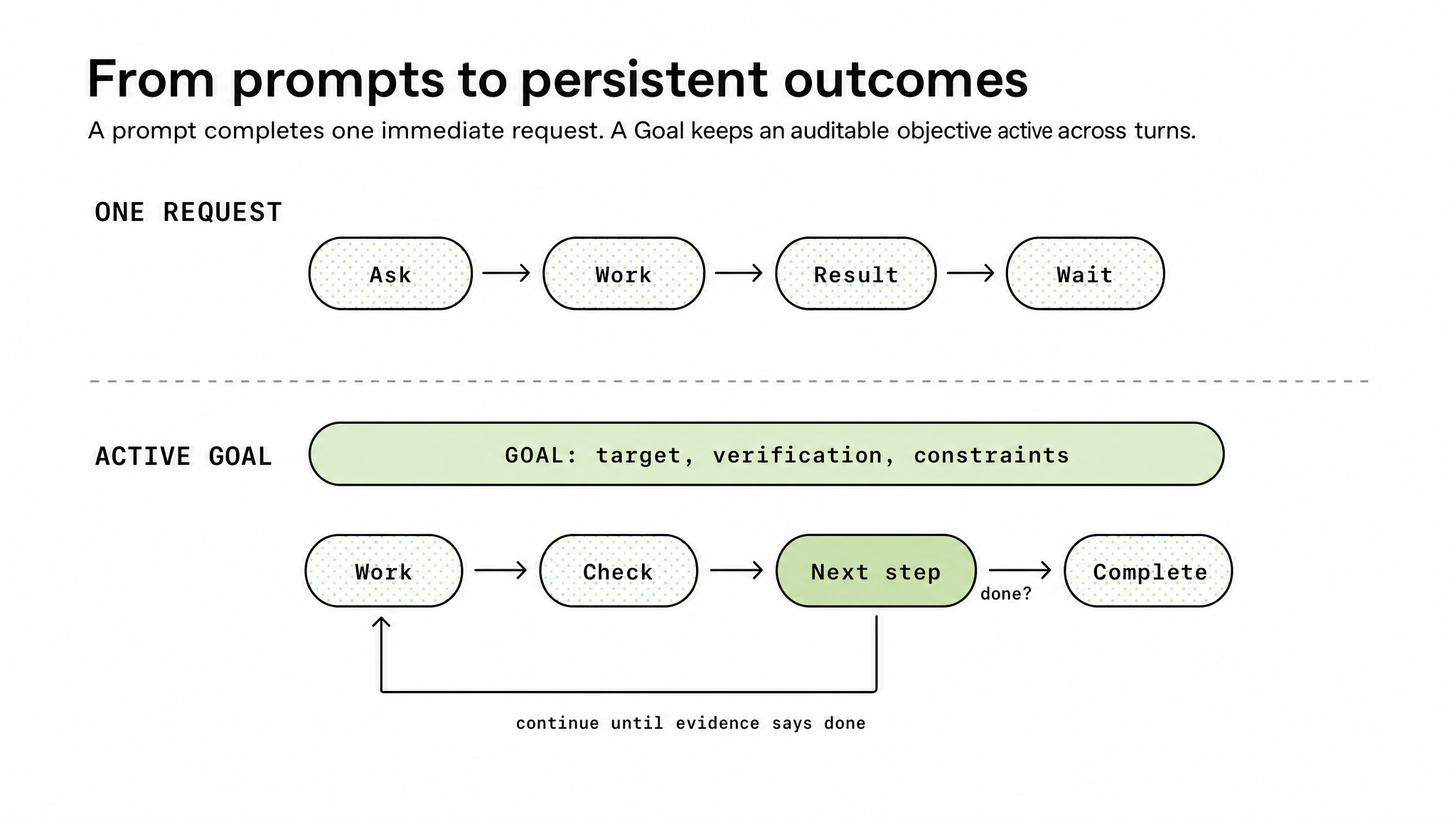
Prompts stop. Goals check.
The objective persists until the evidence says complete or blocked.
Tests, benchmarks, logs, artifacts, or source material become the audit surface.
Correctness, APIs, files, tools, and budget remain explicit.
A strong Goal defines what “done” means.
What should be true when the work is finished.
The test, benchmark, report, artifact, or command output that proves it.
What must not regress while Codex works.
Allowed files, tools, data, repositories, and resources.
How Codex chooses the next best action after each attempt.
When to stop and report attempted paths, evidence, blocker, and needed input.
Start, steer, verify, then stop honestly.
npm install -g @openai/codex@latest
/goal Reduce p95 latency below 120 ms…
Codex inspects code, runs commands, and changes the smallest useful thing.
Benchmarks and tests decide whether the target is met.
If the evidence is not enough, Codex chooses the next action.
/goal pause · resume · clear
Goals persist inside the current thread, not everywhere.
The objective belongs to the thread where files, logs, diffs, and reasoning already live.
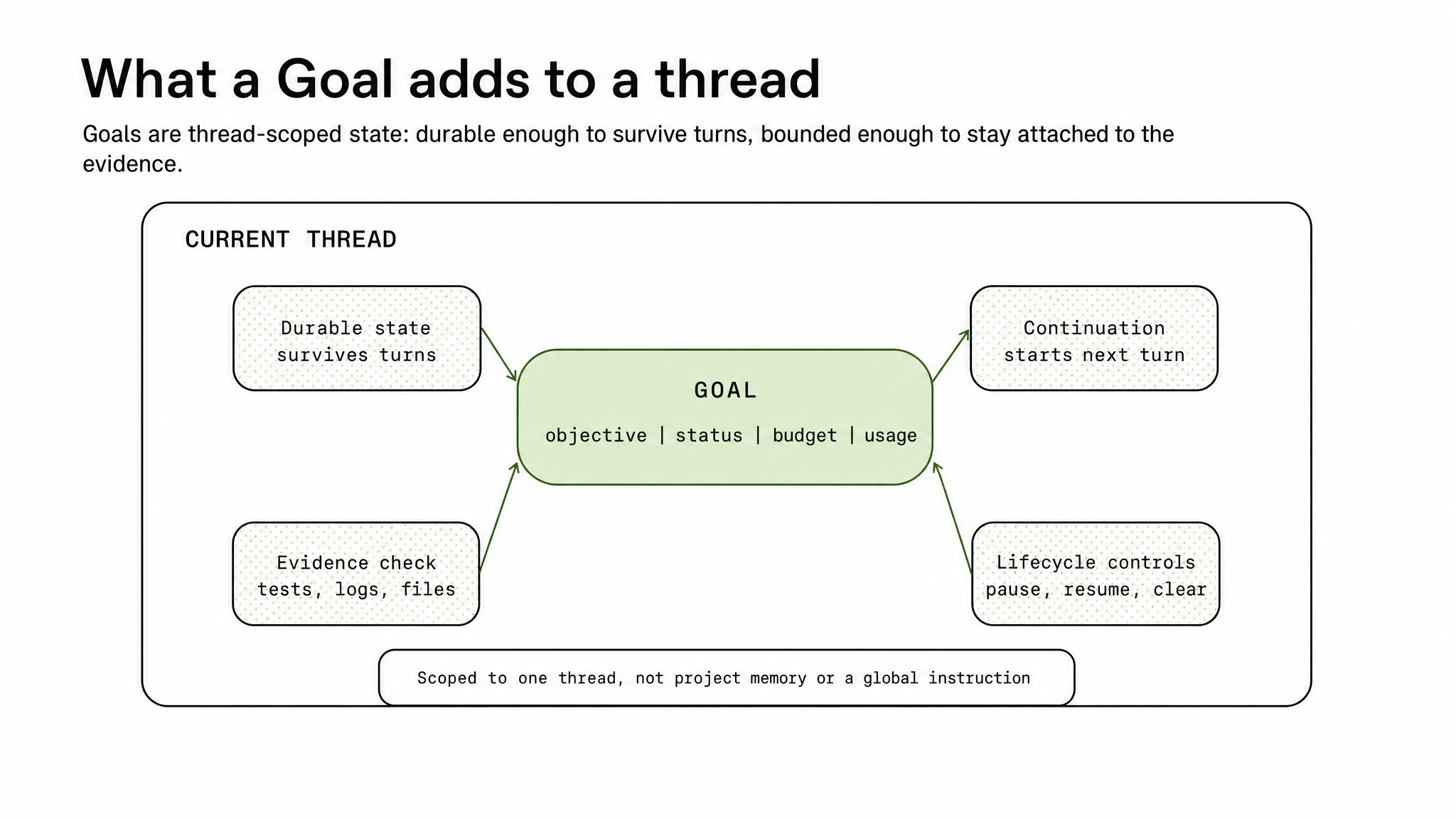
Codex continues only when the thread is idle, active, within budget, and no user input is queued.
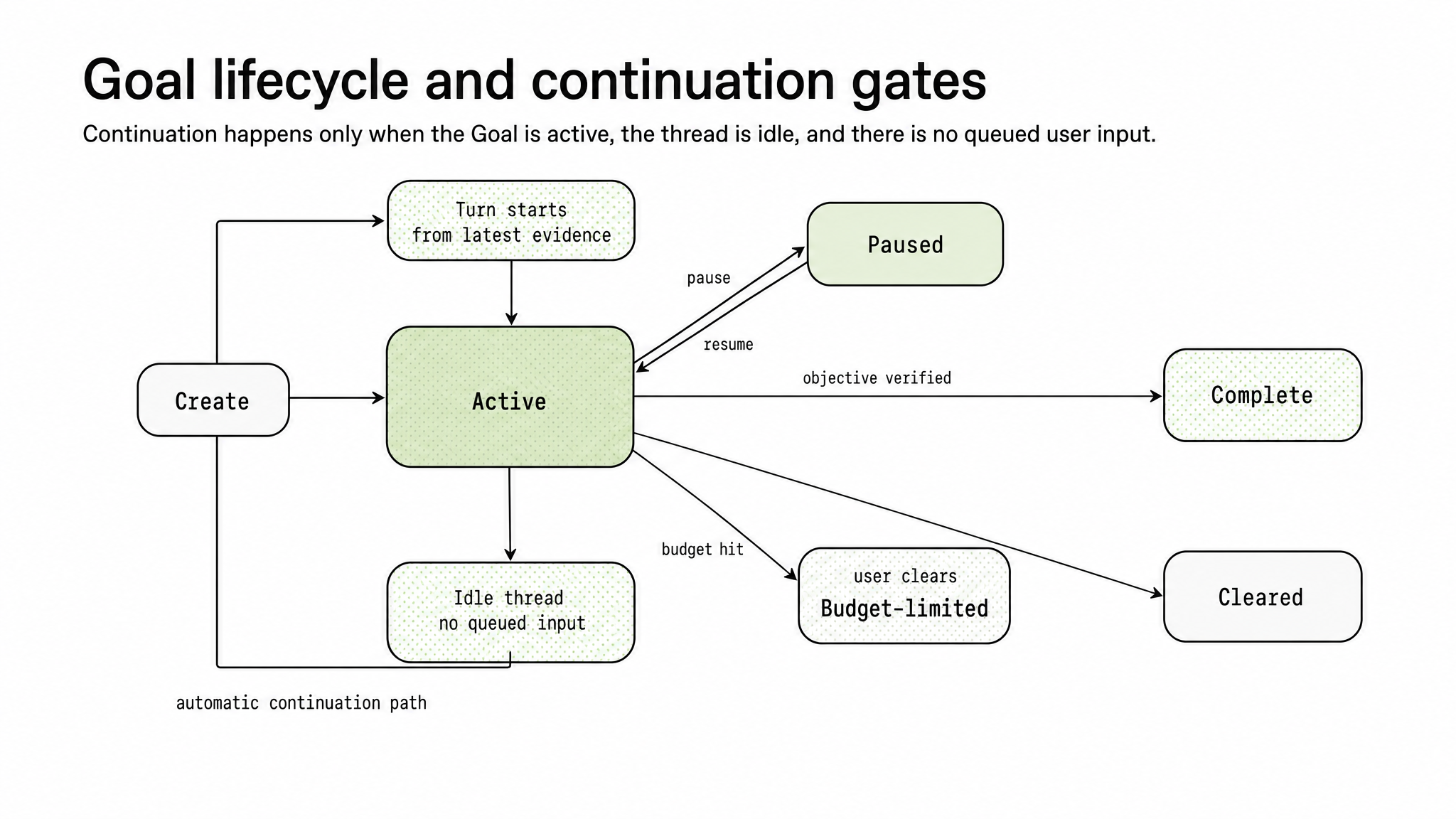
Completion requires concrete files, tests, logs, benchmarks, artifacts, or research evidence.
Budget limits and lifecycle controls prevent infinite loops and preserve user authority.
/goal Improve performance
No finish line. No verification surface. No constraint. Codex cannot know whether to stop, continue, or report uncertainty.
/goal Reduce p95 latency below 120 ms…
Verified by the checkout benchmark, while keeping the correctness suite green. If blocked, report attempted paths, evidence, blocker, and next input needed.
Let the objective persist.
Let evidence decide.
Use Goals for uncertain paths
Debugging, optimization, migrations, flaky tests, benchmarks, and research audits.
Write the evidence first
Name the outcome, audit surface, constraints, boundaries, iteration policy, and blocked stop.
Do not hide uncertainty
If proof is partial, call it partial. If blocked, say what would unlock progress.
설치하고
ulw로 건다.
npx lazycodex-ai install
npx lazycodex-ai install --no-tui --codex-autonomous
Clarify로 목표를 좁힌 뒤, Codex Goal로 검증 표면을 정하고, LazyCodex ulw로 실행 루프를 시작한다.
한 줄 목표가 아니라 evidence loop를 요청한다.
paper URL, repo path, logs, data, formula.
metric, artifact, command output, table.
GPU, time, dataset, framework, search boundary.
first experiment and next-decision rule.
blocked condition and what input unlocks it.
Clarify first.
Goal second.
ulw third.
모호함을 줄인다
가설형 질문으로 연구 요청을 실행 가능한 spec으로 만든다.
완료 기준을 쓴다
Codex Goal은 outcome, evidence, constraint를 붙잡는다.
반복은 evidence로 한다
ulw는 검증될 때까지 이어가되, 막히면 무엇이 필요한지 남긴다.